

 Thomas Unise
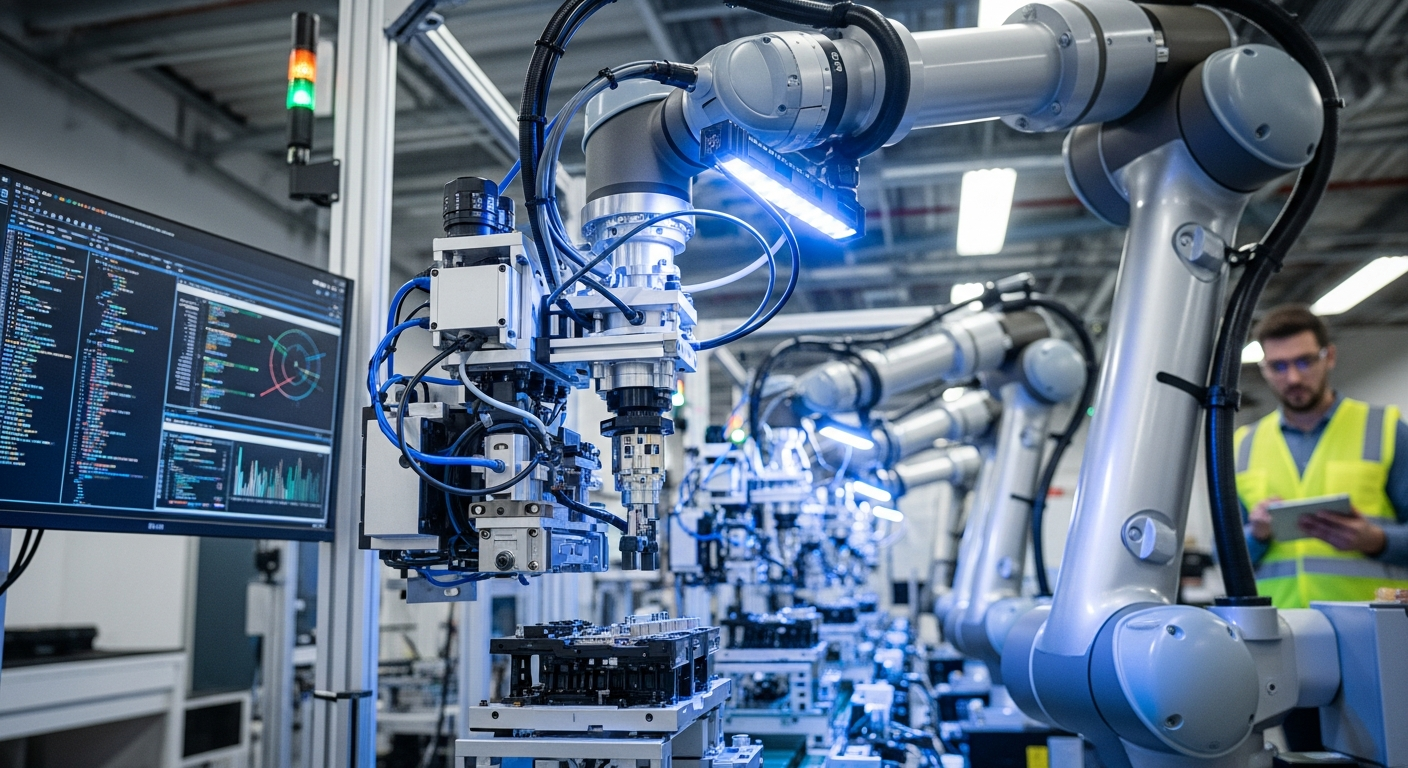
The robotics industry began 2026 with significant momentum, marked by major product launches, strategic partnerships, and technological breakthroughs. From autonomous construction equipment to AI-powered humanoids, January showcased the industry’s rapid evolution across multiple sectors.
Key Developments in Robotics (January 2026)
Amazon made headlines by acquiring Rightbot, a company specializing in unstructured load handling robots, to enhance its logistics capabilities. This strategic move addresses the challenging but essential task of truck loading and unloading, which occurs in variable conditions and environments.
Boston Dynamics demonstrated its Atlas humanoid robot working at a Hyundai manufacturing plant in Georgia during a 60 Minutes feature. This practical application comes amid substantial investment in humanoid robot development, with the sector attracting approximately $4.6 billion in 2025 alone.
Microsoft Research unveiled its Rho-alpha (ρα) model, the first robotics-specific variant from its Phi series. This vision-language-action (VLA) model integrates multiple sensory inputs to help robots operate more effectively in dynamic environments.
In a notable reunion, Boston Dynamics and Google announced a collaboration nearly a decade after parting ways. Google’s DeepMind will integrate its Gemini Robotics foundation models to enhance the intelligence of Boston Dynamics’ next-generation Atlas humanoid.
Commercial Expansions and New Products
Wing Aviation and Walmart revealed plans to significantly scale drone delivery services, adding 150 more Walmart stores to their network. This expansion will make drone delivery accessible to over 40 million Americans, with projections to establish more than 270 delivery locations by 2027.
At CES 2026, Doosan Bobcat introduced the RX3 autonomous concept loader, representing the third generation of its electric-powered autonomous construction equipment. The system aims to simplify operations and boost productivity in construction environments.
In medical robotics, Neocis announced that its Yomi robotic platform has completed over 100,000 osteotomies (bone surgeries). The company also reported successful initial clinical cases using its second-generation system, Yomi S.
Industry Trends and Analysis
Universal Robots’ VP for AI robotics products, Anders Billesø Beck, identified four key physical AI trends for 2026, including advancements in mathematical approaches to robotics problems.
Industry analysts noted that robotics has reached an inflection point where the focus is shifting from potential capabilities to proven, reliable performance in real-world applications. This marks a maturation of the sector as it moves from demonstration to practical implementation.
CES 2026 provided a showcase for the latest robotics innovations, with industry experts offering predictions about which technologies would have lasting impact versus those that might be more hype than substance.
Conclusion
January 2026 demonstrated the robotics industry’s continued expansion into new markets and applications. The month was characterized by major players forming strategic partnerships, next-generation products reaching commercial deployment, and AI integration becoming increasingly sophisticated. As physical AI capabilities advance, robots are moving beyond controlled environments into more dynamic, unstructured settings where they can deliver greater economic and practical value.


GIPHY App Key not set. Please check settings