

 Thomas Unise
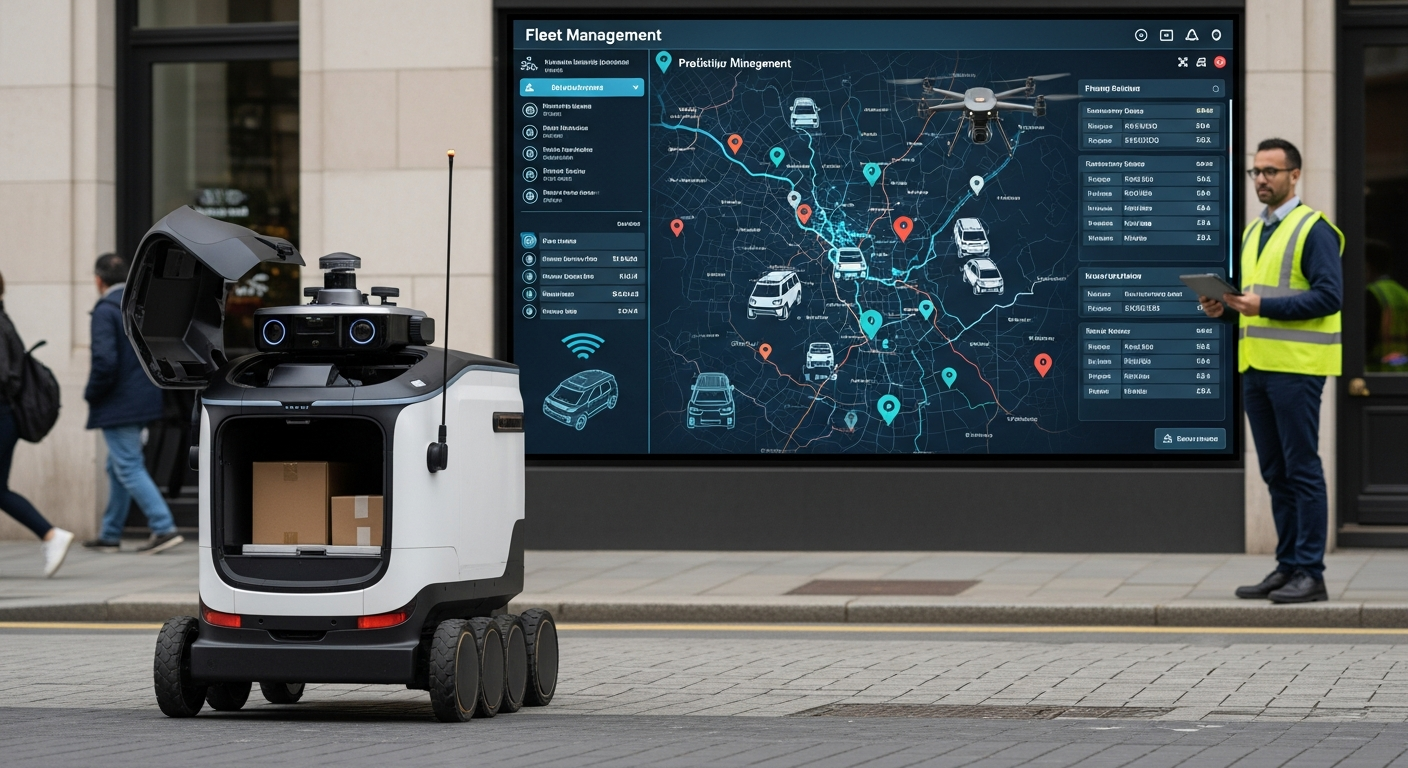
Humanoid, a London-based robotics company, has unveiled KinetIQ, an innovative AI framework designed to orchestrate diverse robot fleets across industrial, service, and home applications. This system uniquely enables a single AI model to control robots with different morphologies and end-effector designs while coordinating interactions between them.
Four-Layer Architecture for Comprehensive Control
KinetIQ operates through four synchronized layers, each handling different timescales from fleet-level assignments to millisecond-level joint control:
System 3: Fleet Orchestration
The highest layer functions as an agentic AI that treats each robot as a tool, optimizing fleet operations across seconds. It integrates with facility management systems, ingests task requests, allocates tasks between wheeled and bipedal robots, and maintains two-way communication with facility systems to track progress and handle exceptions.
System 2: Robot-Level Reasoning
Operating at the second to sub-minute timescale, this layer plans environmental interactions using an omni-modal language model. It observes surroundings, interprets instructions from System 3, and decomposes goals into sub-tasks. The system dynamically updates plans based on visual context rather than relying on pre-programmed sequences, and can request human assistance when needed.
System 1: Vision-Language-Action Task Execution
This neural network commands target poses for robot body parts at a sub-second timescale (5-10Hz). It exposes multiple low-level capabilities to System 2 that can be invoked via different prompts, such as picking objects, manipulating containers, or packing. Each capability reports its status back to System 2 for progress tracking.
System 0: Reinforcement Learning-Based Control
Running at 50Hz, this layer achieves pose targets set by System 1 while solving for all robot joint states to maintain dynamic stability. It uses reinforcement learning-trained whole-body control for both bipedal and wheeled robots, requiring approximately 15,000 hours of simulated experience to produce a capable model.
Cross-Platform Applications
Humanoid has implemented KinetIQ across different robot designs:
- Wheeled-base robots for industrial workflows including grocery picking, container handling, and packing across retail, logistics, and manufacturing
- Bipedal robots serving as R&D platforms for service and household applications, featuring voice interaction, online ordering, and grocery handling
Key Innovations
KinetIQ introduces several technical advances in robot control:
- Cross-timescale architecture that spans from fleet-level decisions to millisecond joint control
- Agentic pattern allowing components to improve independently while scaling to larger fleets
- Asynchronous action execution where new action chunks are prepared while previous ones execute
- Prefix conditioning technique to ensure asynchronously produced chunks align with reality
- Unified control framework applicable across different robot embodiments
By integrating these four cognitive layers across multiple robot types and timescales, KinetIQ aims to achieve complex goals requiring fleet orchestration, reasoning, dexterous manipulation, and dynamic stability control in various environments.

GIPHY App Key not set. Please check settings