

 Thomas Unise
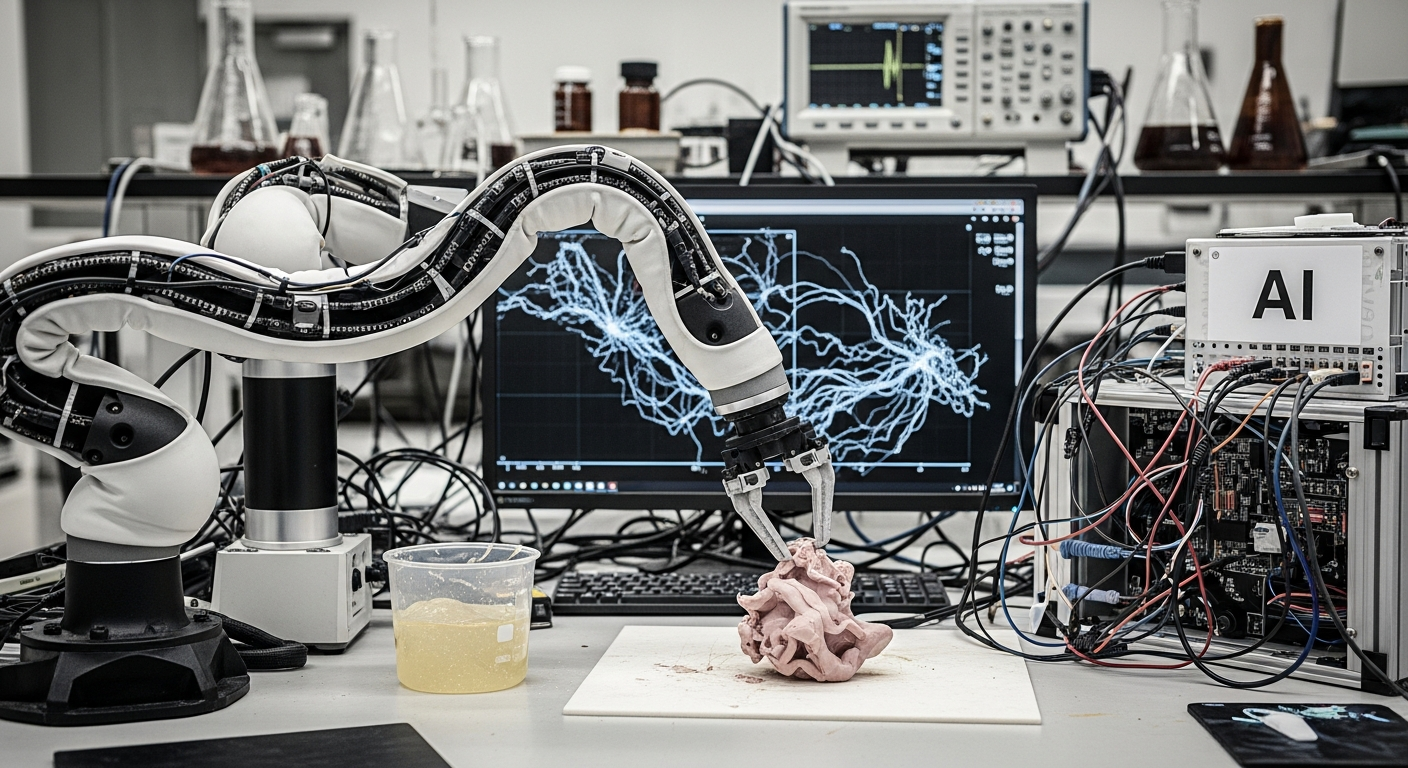
Researchers from the Singapore-MIT Alliance for Research and Technology (SMART) have developed a groundbreaking AI control system that allows soft robotic arms to learn movements once and adapt instantly to changing conditions without requiring retraining. This innovation represents a significant step toward making soft robots more practical for real-world applications.
Breakthrough in Soft Robotics Control
Unlike conventional rigid robots, soft robots are made from flexible materials that can safely interact with humans but have traditionally been difficult to control precisely. The new AI system, developed by the Mens, Manus and Machina (M3S) interdisciplinary research group, overcomes this limitation by combining two complementary sets of “synapses” inspired by how the human brain learns and adapts.
The system utilizes “structural synapses” that are trained offline on foundational movements, providing the robot with built-in skills and a stable foundation. These work alongside “plastic synapses” that continuously update in real-time as the robot operates, fine-tuning its behavior to respond to immediate conditions while maintaining smooth and controlled movements.
Key Capabilities and Achievements
This control system is one of the first to achieve three critical capabilities in a single framework:
- Transferring learning from one task to perform different tasks
- Adapting quickly to changing situations without retraining
- Maintaining stability and safety while adapting movements
In testing, the system demonstrated impressive results across different soft-arm platforms, including:
- 44-55% reduction in tracking error under heavy disturbances
- Over 92% shape accuracy under various challenges including payload changes, airflow disturbances, and actuator failures
- Stable performance even when up to half of the actuators failed
Real-World Applications
The technology has significant implications for various fields:
- Healthcare: Assistive devices for people with limited mobility, rehabilitation robots that adapt to patient progress
- Manufacturing and logistics: Adaptable robots that don’t require constant reprogramming
- Medical robotics: Devices that can respond sensitively to individual patient needs
MIT Professor Daniela Rus, co-lead principal investigator and director of MIT’s Computer Science and Artificial Intelligence Laboratory (CSAIL), noted that this development brings us “a step closer to a future where versatile soft robots can operate safely and intelligently alongside people — in clinics, factories, or everyday lives.”
Future Directions
The research team plans to extend this technology to robotic systems that can operate at higher speeds in more complex environments. They envision applications in assistive robotics, medical devices, industrial soft manipulators, and integration into real-world autonomous systems.
This breakthrough represents a paradigm shift from task-specific capabilities toward a truly generalizable framework with human-like intelligence, opening doors for more robust soft robotic systems across multiple industries.



GIPHY App Key not set. Please check settings