

 Thomas Unise
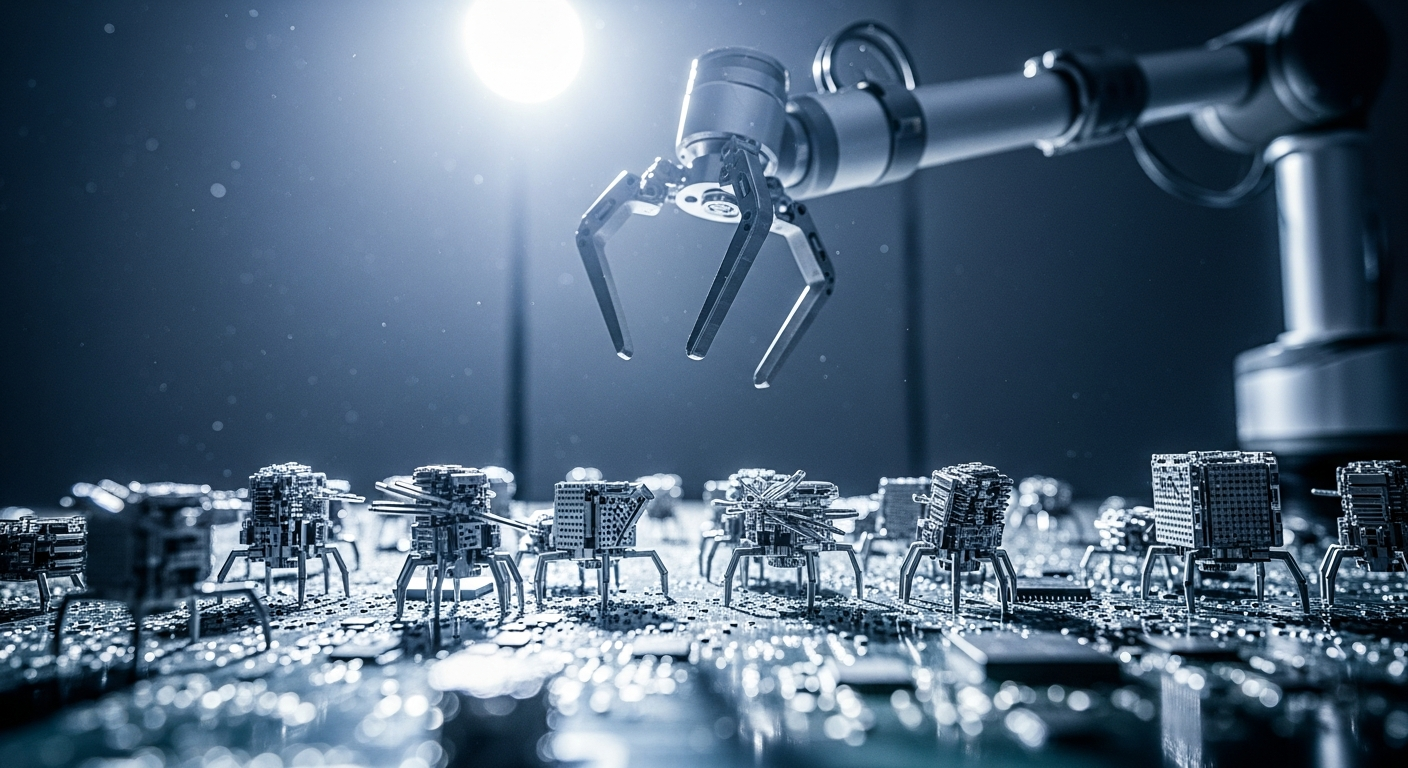
Researchers at the University of Pennsylvania and the University of Michigan have developed what they claim to be the world’s smallest fully programmable, autonomous robots. These microscopic swimming machines, smaller than a grain of salt, can independently sense their environment, operate for months, and cost just a penny each.
Breakthrough in Microscale Robotics
The tiny robots measure approximately 200 by 300 by 50 micrometers, making them barely visible to the naked eye. Unlike previous microrobots, these devices operate without external controls such as tethers, magnetic fields, or joysticks, representing the first truly autonomous programmable robots at this scale.
“We’ve made autonomous robots 10,000 times smaller,” explained Marc Miskin, assistant professor at Penn Engineering and the paper’s senior author. “That opens up an entirely new scale for programmable robots.”
Innovative Propulsion System
The researchers had to completely rethink how these robots move. Rather than using traditional limbs or appendages, which are ineffective at microscale, the robots generate an electrical field that moves ions in the surrounding solution. This creates a flow of water around the robot’s body, propelling it forward at speeds of up to one body length per second.
The robots can adjust this electrical field to move in complex patterns and even travel in coordinated groups. With no moving parts, the robots are extremely durable and can operate for months when charged by an LED light.
Microscale Computing Power
David Blaauw’s team at the University of Michigan contributed the world’s smallest computer to the project. Despite working with only 75 nanowatts of power—over 100,000 times less than a smartwatch—the team developed special low-voltage circuits and condensed programming instructions to fit in the robot’s tiny memory space.
“We had to totally rethink the computer program instructions,” said Blaauw, explaining how they compressed multiple propulsion control instructions into a single command to fit the limited memory.
Sensing and Communication Capabilities
The robots feature electronic sensors that can detect temperature changes within a third of a degree Celsius. This allows them to move toward areas of increasing temperature or report temperature data, which can serve as a proxy for cellular activity.
To communicate their findings, the robots perform a special “dance” that encodes information in their movements. Researchers can observe and decode these movements through a microscope with a camera.
Potential Applications
Operating at the scale of biological microorganisms, these robots could revolutionize several fields:
- Medicine: Monitoring the health of individual cells
- Manufacturing: Assisting in the construction of microscale devices
- Research: Performing tasks at previously inaccessible scales
Future Developments
The researchers describe this as “just the first chapter” in microscale robotics. Future versions could store more complex programs, move faster, integrate new sensors, or operate in more challenging environments. The current design serves as a general platform that can be enhanced with additional intelligence and functionality.
“We’ve shown that you can put a brain, a sensor and a motor into something almost too small to see, and have it survive and work for months,” Miskin said. “Once you have that foundation, you can layer on all kinds of intelligence and functionality. It opens the door to a whole new future for robotics at the microscale.”


GIPHY App Key not set. Please check settings