

 Thomas Unise
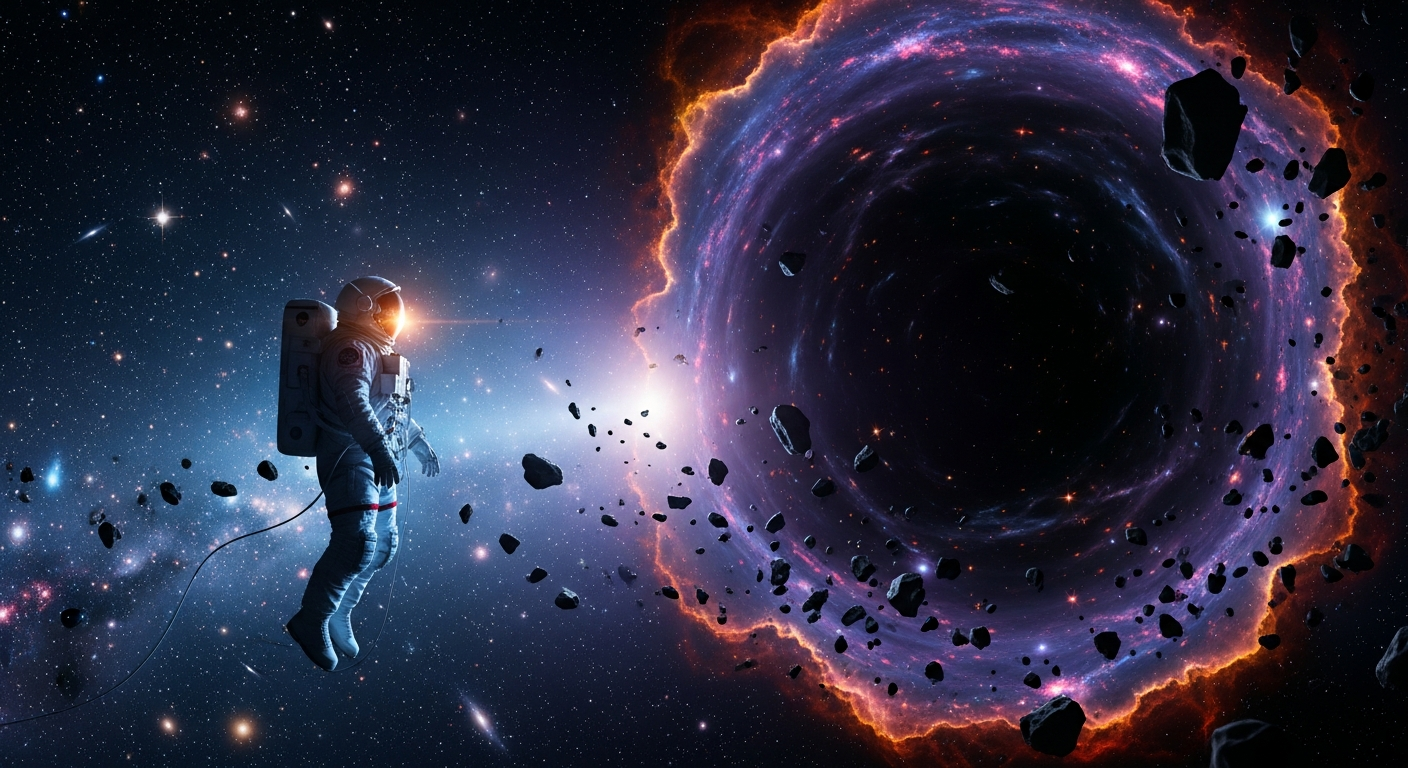
NASA plans to use its upcoming Nancy Grace Roman Space Telescope to investigate mysterious cosmic voids—vast regions of space containing few or no galaxies—that could provide crucial insights into dark energy and the universe’s evolution.
Understanding Cosmic Voids
Cosmic voids are enormous empty regions of space spanning tens to hundreds of millions of light years across. Rather than being truly empty, these voids may hold the key to understanding fundamental cosmic forces, particularly dark energy and dark matter.
These voids potentially challenge the cosmological principle, which suggests that on the largest scales, matter should be evenly distributed throughout the universe. Instead, galaxies appear to cluster on the surfaces of bubble-like structures, with voids at their centers.
The Roman Telescope’s Mission
Set to launch in October 2023, the Roman Space Telescope will conduct the High-Latitude Wide-Area Survey, examining the night sky away from our galaxy’s plane. According to a new study published in The Astrophysical Journal:
- The telescope is expected to detect and measure tens of thousands of cosmic voids
- It can identify voids as small as 20 million light-years across
- Researchers will study the shapes of these voids, which are influenced by dark energy
- Non-spherical voids could challenge current assumptions about dark energy
Dark Energy Research
Astronomers believe voids offer a unique opportunity to study dark energy, the mysterious force thought to make up nearly 70% of the universe and drive its accelerating expansion. As study co-author Alice Pisani explained, “Since they’re relatively empty of matter, voids are regions of space that are dominated by dark energy.”
By contrast, ordinary matter—the stuff that makes up planets and stars—accounts for less than 5% of the universe’s content.
Scientific Implications
The study of cosmic voids could help resolve ongoing debates about the cosmological principle. These voids might either disprove the principle or, viewed on a large enough scale, form part of a homogeneous cosmic structure.
As co-author Giulia Degni noted, the Roman Telescope will enable scientists to better observe the sparse, faint galaxies that populate voids, ultimately providing “greater understanding of the cosmological parameters like dark energy that are sculpting voids.”



GIPHY App Key not set. Please check settings