

 Thomas Unise
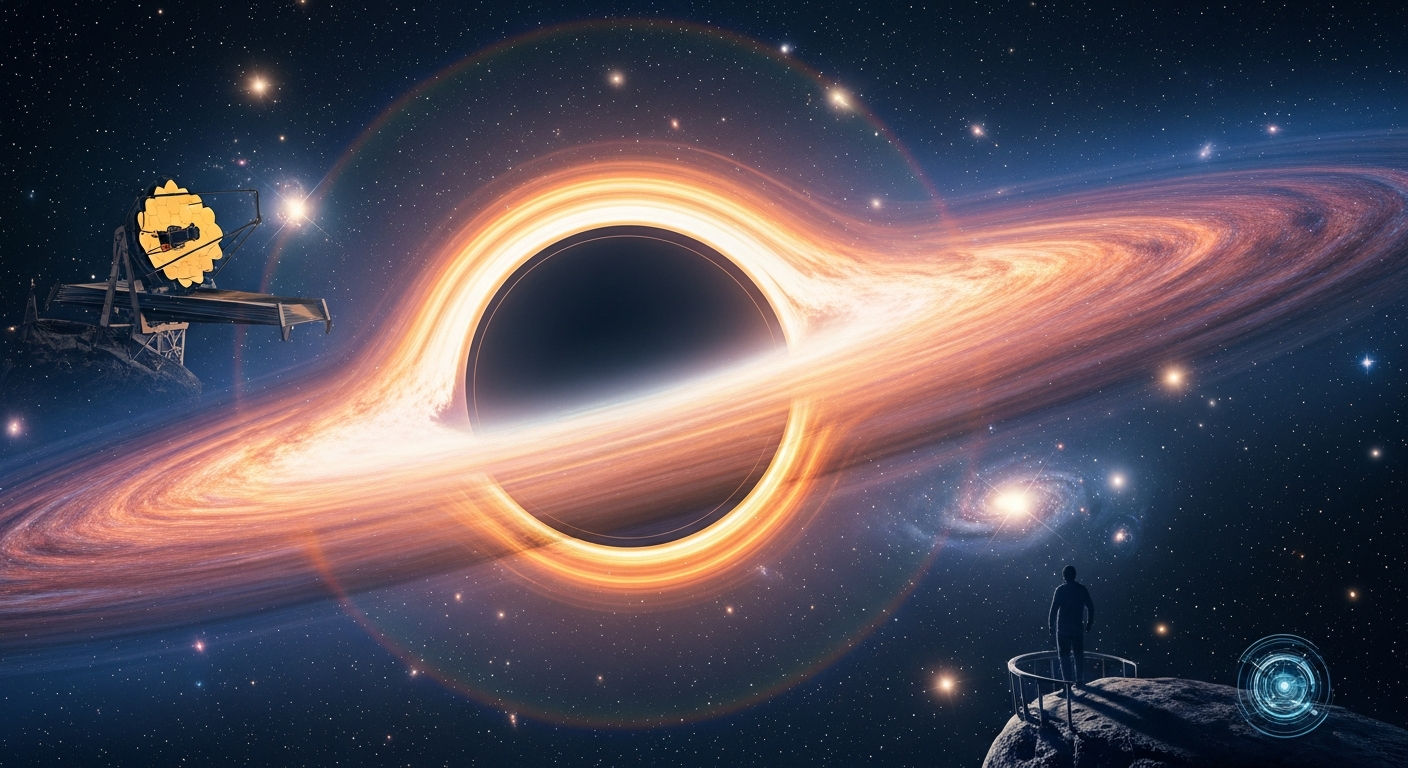
Astronomers have potentially discovered the first runaway supermassive black hole, traveling at an astonishing 2.2 million miles per hour through space, according to observations made with NASA’s James Webb Space Telescope.
A Groundbreaking Astronomical Discovery
This massive cosmic entity, weighing approximately 10 million times the mass of our Sun, was spotted careening through the “Cosmic Owl” – a pair of interacting galaxies located about eight billion light-years away. If confirmed, it would be not only the first object of its kind ever detected but potentially one of the fastest-moving celestial bodies ever observed.
The black hole’s journey is creating spectacular cosmic phenomena, including a massive “bow-shock” of matter in front of it (comparable to an entire galaxy in size) and a 200,000 light-year-long tail of gas behind it where new stars are forming.
Detection and Confirmation
Yale University astronomer Pieter van Dokkum, lead author of the research paper (which awaits peer review), first spotted this unusual object in 2023 using the Hubble Space Telescope. However, the James Webb Space Telescope was crucial in analyzing the enormous amount of gases being displaced by the object, helping to confirm its nature.
“It is moving at approximately 620 miles per second, faster than just about any other object in the universe,” van Dokkum explained to Space.com. This incredible speed is what enabled the black hole to escape the gravitational pull of its former galactic home.
How Did It Happen?
The researchers propose two possible explanations for how this supermassive black hole was ejected at such tremendous speeds:
- A collision with another supermassive black hole, releasing enormous gravitational waves that propelled it forward
- A “three-body interaction” where the black hole crashed into a binary black hole system, creating an unstable situation
The team currently favors the first explanation, suggesting this runaway black hole was likely ejected after colliding with a single black hole during a galactic merger event.
Implications for Astronomy
This discovery opens new avenues for understanding how supermassive black holes interact during galaxy mergers. Van Dokkum suggests that now that astronomers know how to identify such objects, they can search for more examples and gather empirical data on how frequently these cosmic ejections occur.
The finding adds an intriguing new dimension to our understanding of supermassive black holes, which have been observed at the center of almost every galaxy, including our own Milky Way (where Sagittarius A* resides).



GIPHY App Key not set. Please check settings