

 Thomas Unise
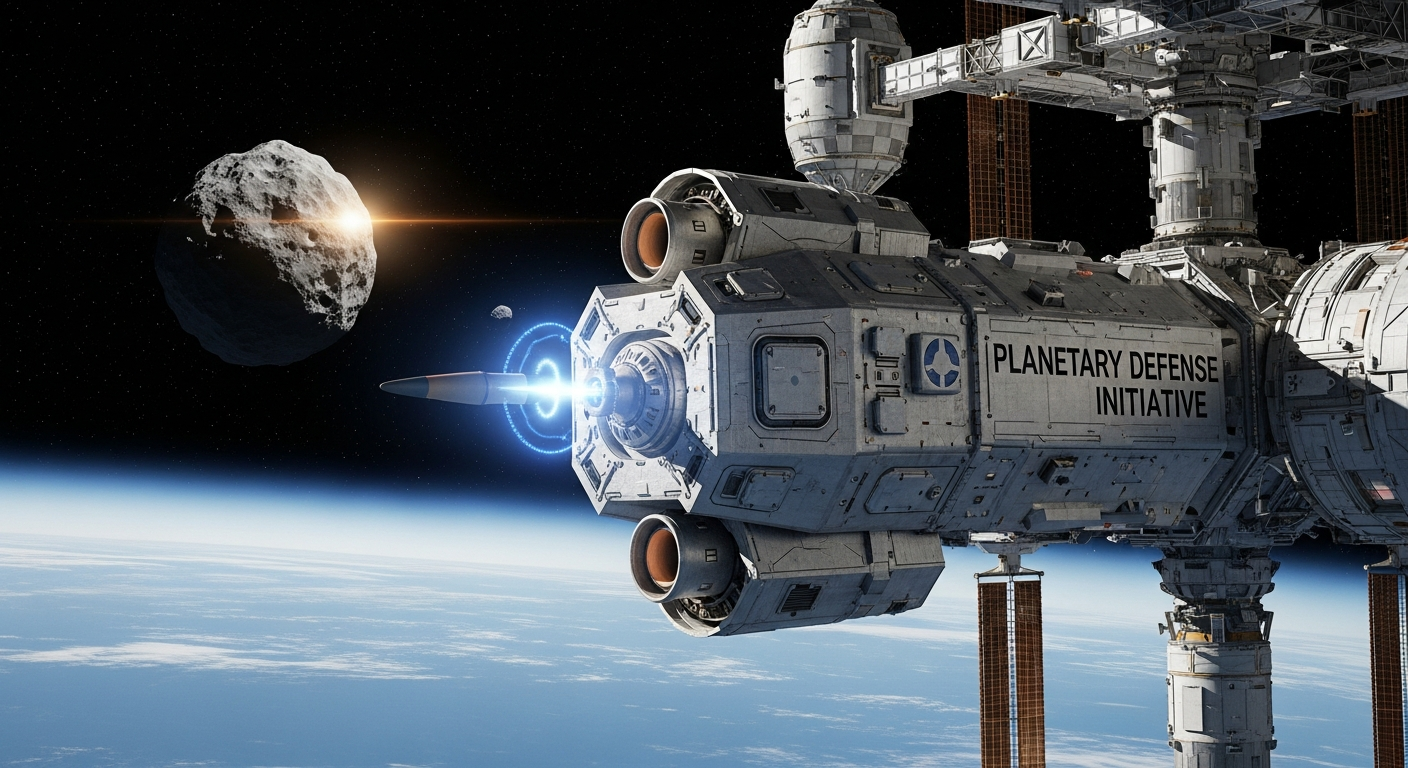
Scientists have discovered that asteroids are more resilient than expected when exposed to extreme forces, potentially making nuclear deflection a viable option for planetary defense.
Key Findings on Asteroid Deflection
A new study published in Nature Communications has revealed surprising results about how asteroids might react to nuclear deflection attempts. Researchers from CERN and the University of Oxford, in partnership with nuclear deflection startup Outer Solar System Company (OuSoCo), conducted experiments to test asteroid material resilience under conditions simulating nuclear impacts.
Using CERN’s Super Proton Synchrotron (SPS), scientists exposed meteorite samples to intense proton beam pulses and then analyzed the microscopic structural changes. Contrary to expectations, the material actually became stronger after exposure, showing “an increase in yield strength” and “self-stabilizing damping behavior.”
Implications for Planetary Defense
This research addresses a critical concern about using nuclear weapons against asteroids: the fear that they might shatter into multiple dangerous fragments, creating a “shotgun blast” effect of debris heading toward Earth. The findings suggest that metal-rich asteroids may be able to withstand larger nuclear devices without catastrophic fragmentation.
As Melanie Bochmann from OuSoCo explained, this “keeps open an emergency option for situations involving very large objects or very short warning times, where non-nuclear methods are insufficient.” This approach could complement other deflection methods like NASA’s DART mission, which successfully demonstrated the kinetic impact technique in 2022.
Future Research Opportunities
Scientists plan to expand their research to include more complex rocky asteroid materials, including pallasites—meteorites consisting of metal matrices with embedded magnesium-rich crystals. These studies could provide insights not only for planetary defense but also for understanding planetary formation processes.
The upcoming close approach of asteroid Apophis in April 2029, which will pass within 20,000 miles of Earth, will provide NASA and the European Space Agency with valuable opportunities to gather more data on asteroid composition and behavior.
Why This Matters
Asteroid impacts pose a genuine threat to Earth, as demonstrated by the 2013 Chelyabinsk meteor that exploded over Russia with energy equivalent to 30 Hiroshima bombs. Having multiple viable defense strategies is crucial for planetary protection, especially when facing larger asteroids or short warning times.
As Karl-Georg Schlesinger of OuSoCo noted, “The world must be able to execute a nuclear deflection mission with high confidence, yet cannot conduct a real-world test in advance.” These laboratory experiments provide essential data for developing effective defense strategies without requiring actual nuclear tests in space.



GIPHY App Key not set. Please check settings