

 Thomas Unise
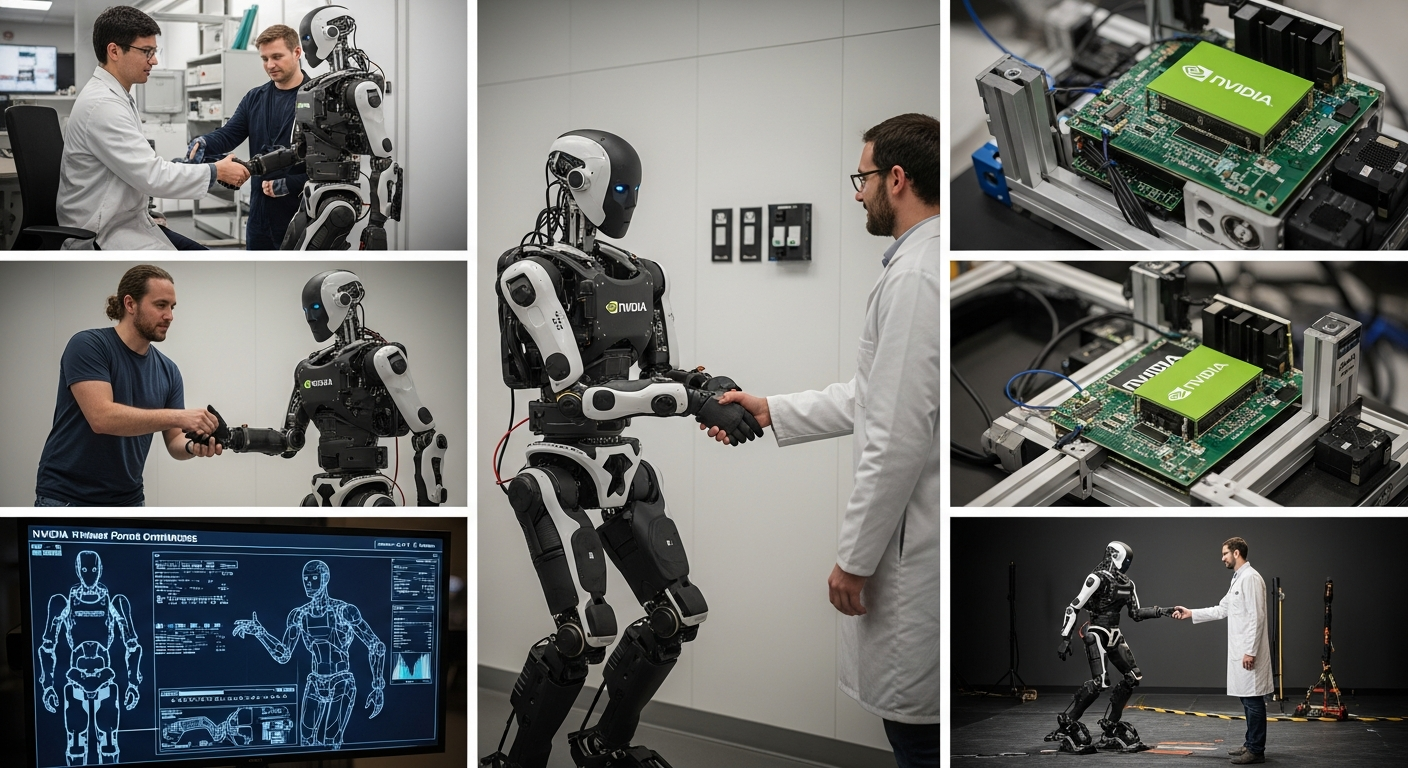
London-based startup Humanoid has dramatically compressed the traditional robotics development cycle by creating functional HMND 01 Alpha prototypes in just seven months instead of the industry-standard 18-24 months. This achievement relies heavily on NVIDIA’s integrated hardware and software stack, enabling both wheeled industrial and bipedal research platforms to move quickly from concept to field testing.
Edge Computing and AI Foundation Models
The HMND 01 Alpha uses NVIDIA Jetson Thor as its primary edge-computing platform, allowing the robot to run large-scale foundation models directly on the device. This approach reduces system complexity, simplifies field serviceability, and enables vision-language-action (VLA) models to operate on the robot itself. Using NVIDIA’s AI infrastructure has cut post-training processing times to just hours, significantly accelerating the development cycle.
Simulation-First Development Approach
Humanoid’s development workflow centers on a simulation-to-reality pipeline built with NVIDIA Isaac Lab and Isaac Sim. This environment allows engineers to:
- Train reinforcement learning policies for locomotion and manipulation
- Develop and deploy new policies onto physical hardware in approximately 24 hours
- Test middleware, control systems, and teleoperation setups virtually
- Validate SLAM and navigation policies before hardware implementation
The company also developed a custom hardware-in-the-loop validation system, creating digital twins that use the same software interfaces as the physical robots.
Physics-Based Hardware Optimization
Rather than using simulation solely for software validation, Humanoid leverages it for mechanical engineering optimization. During the bipedal robot’s design phase, engineers evaluated six different leg configurations in Isaac Sim, analyzing torque requirements, mass distribution, and joint stability. This approach enabled them to optimize actuator selection, joint strength, and sensor placement before manufacturing physical prototypes.
Transition to Software-Defined Standards
Humanoid is collaborating with NVIDIA to develop a new robotics networking system that moves beyond legacy industrial communication standards. This partnership aims to create an open network standard for AI-enabled robots built on Jetson Thor and the Holoscan Sensor Bridge, potentially transforming the industry through software-defined robotics.
HMND 01 Variants and Applications
Humanoid offers two versions of its HMND 01 Alpha robot:
- Wheeled Variant: Designed for immediate industrial use in logistics and warehousing, featuring a 4-wheel high-stability base, 29 degrees of freedom, 15kg payload capacity, and 8-hour battery life
- Bipedal Variant: Currently a research and development tool for future household applications, featuring dynamic balance, full-body 29 degrees of freedom, and 3-4 hour battery life with swappable batteries
Company Growth and Market Traction
Founded in 2024 by Artem Sokolov, Humanoid now employs over 200 engineers and researchers across offices in London, Boston, and Vancouver. The company reports 20,500 pre-orders and has three active pilot programs, focusing on gathering performance data from early operational deployments to iterate on its software-defined architecture.


GIPHY App Key not set. Please check settings