

 Thomas Unise
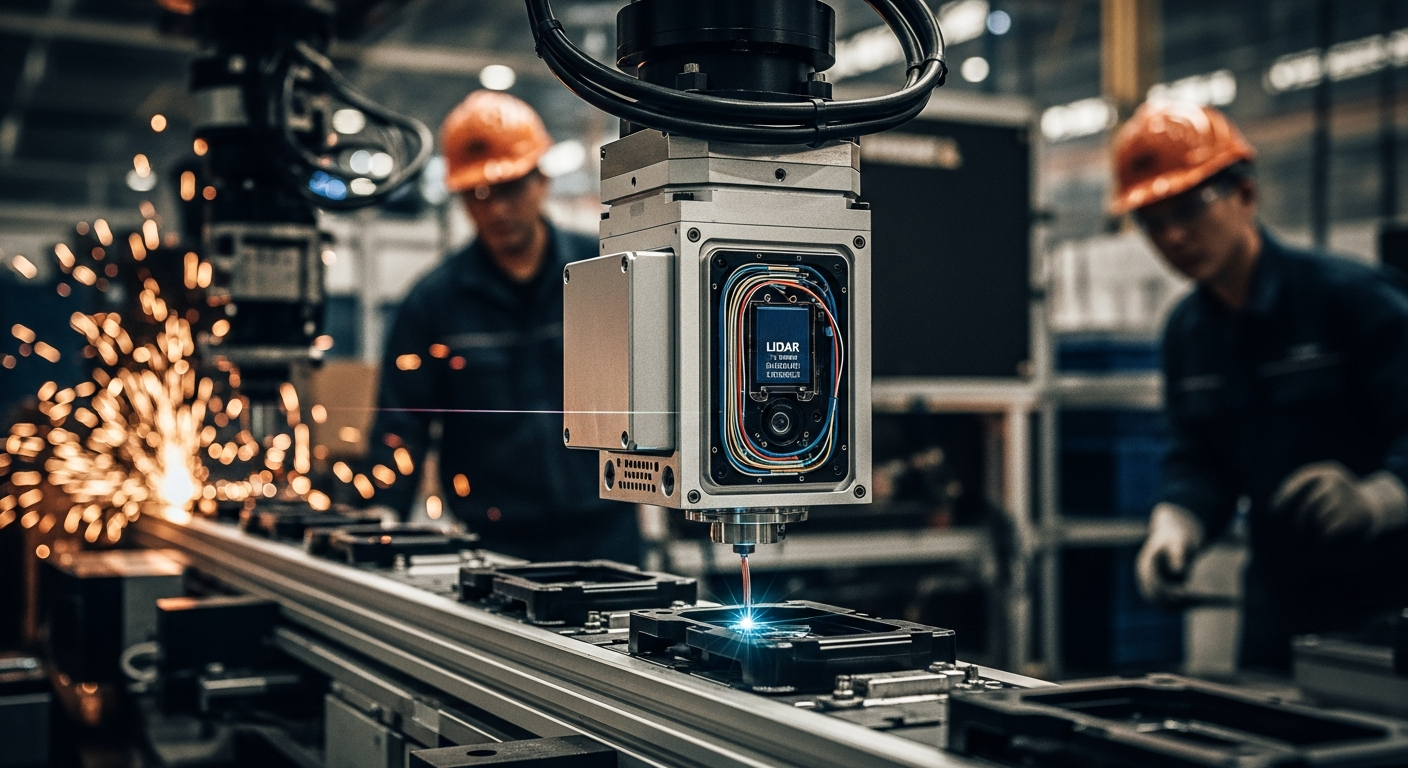
The industrial automation landscape is rapidly evolving, with robots, forklifts, and mobile platforms becoming increasingly common in factories and warehouses. This shift has created an urgent demand for advanced sensing technologies that can provide machines with human-like perception capabilities. While the global warehouse automation market is projected to double from $30 billion to $60 billion by 2030, current sensing technologies face significant limitations in meeting the precision, reliability, and affordability requirements of industrial autonomy.
The Limitations of Current Sensing Technologies
Traditional vision systems struggle with environmental variables like glare, shadows, and low-light conditions. Time-of-flight sensors lose precision over distance and in bright lighting. Conventional lidars remain expensive and difficult to scale. Industrial environments add further complications with reflective surfaces, dust, and potential sensor cross-talk when multiple robots operate simultaneously.
FMCW Lidar: A Breakthrough Technology
Frequency modulated continuous wave (FMCW) lidar represents a significant advancement in 3D sensing. Unlike traditional time-of-flight lidar that measures the return time of laser pulses, FMCW lidar emits a continuous beam with steadily changing frequency. When reflected light returns, it’s mixed with the transmitted signal, revealing both distance and velocity information simultaneously.
Key advantages of FMCW lidar include:
- Combined range and velocity measurement in a single scan
- Immunity to sunlight and ambient light interference
- Freedom from cross-talk in multi-robot environments
- High signal-to-noise ratio that maintains accuracy in challenging conditions
Silicon Photonics: Making Lidar Scalable
The integration of FMCW lidar with silicon photonics technology enables unprecedented scalability. By integrating light emission, beam steering, and detection onto a single photonic chip, these systems eliminate bulky optics and moving parts. Manufacturing can leverage mature semiconductor foundries, resulting in miniaturization, improved reliability, affordability, and consistent performance across robot fleets.
Transformative Industrial Applications
Chip-scale FMCW lidar enables several critical industrial automation applications:
1. Pallet Handling and Forklift Guidance
Compact lidar modules mounted on forklifts provide high-resolution 3D data with sub-centimeter precision for accurate pallet engagement, even with irregular loads or reflective surfaces. This reduces collisions and increases throughput.
2. Robotic Picking and Object Manipulation
Integrated directly into robot arms, these sensors enable precise object identification and optimal grasp planning, even for items with varying shapes and reflective packaging.
3. Mobile Platform Navigation
FMCW lidar provides ego-motion estimation through Doppler-based velocity sensing, improving localization accuracy and reducing dependence on external markers or GPS.
4. Safety and Human-Robot Collaboration
Velocity-aware sensing enables predictive collision avoidance, distinguishing between stationary obstacles and moving humans in a single scan for safer collaborative environments.
5. Mixed Environment Operations
Unlike cameras or ToF systems, FMCW lidar operates reliably in transitions between indoor and outdoor environments, unaffected by changing lighting conditions.
The Physical AI Revolution
The convergence of advanced sensing with artificial intelligence represents the next frontier in automation. For this “Physical AI” to become widespread, sensing technology must follow the same scalability path as computing—transitioning from custom hardware to integrated chips produced at scale. Silicon photonics-based FMCW lidar makes this possible by enabling perception systems that can be manufactured like semiconductors.
Economic Impact
Affordable, scalable lidar fundamentally changes the economics of industrial autonomy. Robots equipped with these compact, high-fidelity sensors can operate more safely, adapt to changing environments, and deliver faster ROI through reduced errors and simpler integration. This signals a transition from automation as a project to autonomy as a platform—creating the foundation for the next wave of industrial productivity.


GIPHY App Key not set. Please check settings