

 Thomas Unise
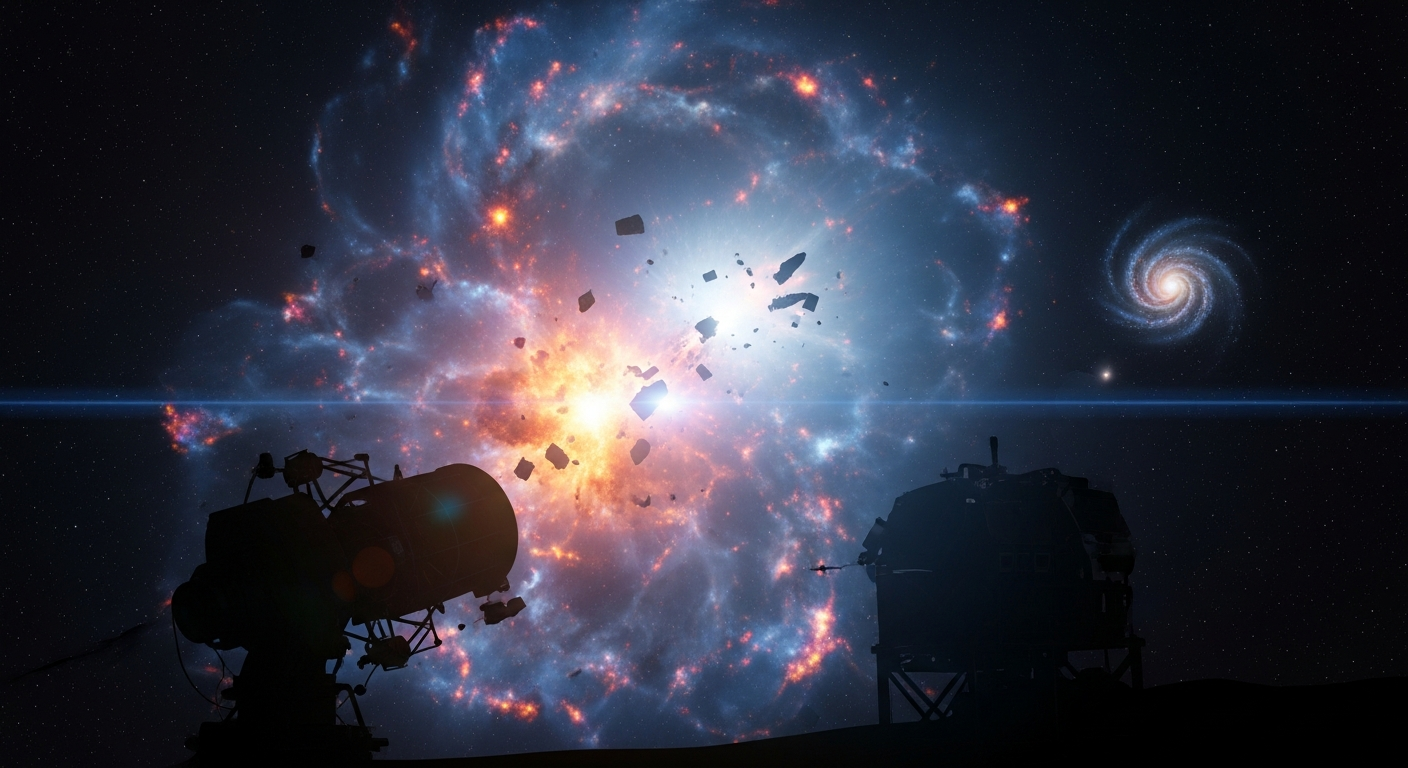
Astronomers believe they’ve witnessed an unprecedented cosmic event: a star that split in half before merging back together, creating a massive double explosion that’s being called a potential “superkilonova.” This remarkable phenomenon, designated AT2025ulz, could represent an entirely new class of astrophysical events.
The Discovery and Mixed Signals
Located 1.3 billion light years away, AT2025ulz first caught astronomers’ attention on August 18, 2025, when two observatories detected powerful gravitational waves suggesting a merger between two massive objects. Hours later, the Zwicky Transient Facility in California observed a rapidly fading red object consistent with a kilonova’s aftermath.
However, the situation became more complex days later when the object unexpectedly brightened, turned blue, and displayed hydrogen across its light spectra—characteristics typically associated with supernovas rather than kilonovas.
The Superkilonova Hypothesis
Led by Caltech astronomer Mansi Kasliwal, researchers propose that AT2025ulz may be neither a standard supernova nor a kilonova, but rather a “superkilonova”—a completely new phenomenon. The team suggests the following sequence of events:
- An original star exploded in a supernova
- This explosion essentially split the star into two smaller neutron stars
- Trapped inside the supernova remnants, these twin neutron stars spiraled together
- The neutron stars then collided and exploded as a kilonova
- The kilonova signature was initially hidden by the original star’s remains
Supporting this hypothesis, gravitational wave data indicated that at least one of the merged objects was less massive than our Sun.
Scientific Significance
While this discovery doesn’t yet constitute definitive proof of a superkilonova, it represents a potentially groundbreaking observation in astrophysics. Kilonovas themselves are extremely rare—only one has been confirmed to date, with estimates suggesting just ten star systems in the entire Milky Way will ever produce such explosions.
“We do not know with certainty that we found a superkilonova, but the event nevertheless is eye opening,” Kasliwal stated in the research published in The Astrophysical Journal Letters.
This discovery could reshape our understanding of stellar evolution and the cosmic processes that create heavy elements throughout the universe. If confirmed, the superkilonova would add an entirely new category to the spectacular ways stars can end their lives.


GIPHY App Key not set. Please check settings