

 Thomas Unise
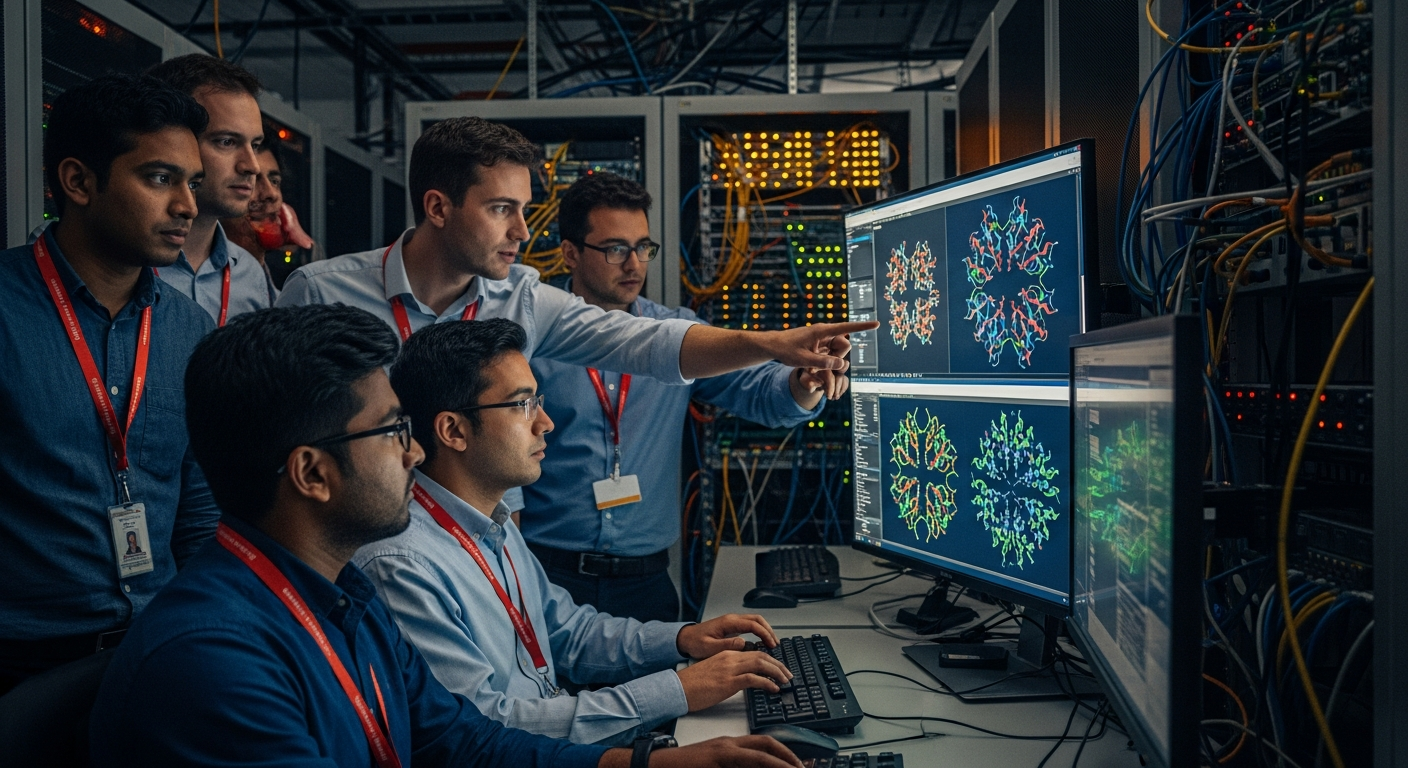
Five years after its debut, AlphaFold, Google DeepMind’s groundbreaking AI system for predicting protein structures, has transformed biological research and continues to expand its capabilities. From gaming to scientific breakthroughs, DeepMind’s journey represents one of AI’s most significant contributions to science.
The Evolution of AlphaFold
When AlphaFold2 launched in November 2020, it marked DeepMind’s transition from creating AIs that mastered games like Go to solving fundamental scientific challenges. The system achieved what was previously thought impossible: predicting three-dimensional protein structures with atomic-level accuracy.
Today, AlphaFold’s database contains over 200 million predicted protein structures—essentially the entire known protein universe—and serves nearly 3.5 million researchers across 190 countries. The 2021 Nature article describing the algorithm has been cited 40,000 times, underscoring its scientific impact.
From AlphaFold 2 to AlphaFold 3
AlphaFold 3, released in 2023, represents a significant advancement by extending AI capabilities beyond proteins to DNA, RNA, and drug molecules. This evolution hasn’t been without challenges, including “structural hallucinations” in disordered protein regions, but it signals progress toward more comprehensive biological modeling.
According to Pushmeet Kohli, vice president of research at DeepMind and architect of the AI for Science division, their approach focuses on “root node problems”—areas where solutions would transform science but where conventional methods fall short.
The AI Co-Scientist Approach
DeepMind is now developing an “AI co-scientist” built on their Gemini 2.0 model. This system uses multiple AI agents to generate hypotheses, debate findings, and collaborate with human researchers. Rather than replacing scientists, it aims to handle more of the “how” aspects of research, freeing humans to focus on determining which questions are worth asking.
In one example, researchers at Imperial College used this system to study how certain viruses hijack bacteria, potentially opening new approaches to tackling antimicrobial resistance. The AI rapidly analyzed decades of research to generate hypotheses, while human scientists designed validation experiments and interpreted the significance.
The Future of AI in Science
Looking ahead, Kohli identifies understanding complete cellular systems and deciphering the genome as critical frontiers. The ultimate goal—simulating an entire cell—remains years away but would revolutionize medicine by enabling computational testing of drug candidates and personalized treatment design.
DeepMind’s approach balances innovation with verification, pairing creative generative models with rigorous verification systems. This “harness” architecture helps address concerns about hallucinations in diffusion models like those used in AlphaFold 3.
Key Achievements
- Created a database of 200+ million protein structures
- Used by 3.5 million researchers globally
- Extended capabilities from proteins to DNA, RNA, and drug molecules
- Developed multi-agent systems that debate scientific hypotheses
As AlphaFold enters its next five years, it exemplifies how AI can accelerate scientific discovery while maintaining the crucial role of human researchers in directing and interpreting research.



GIPHY App Key not set. Please check settings