

 Thomas Unise
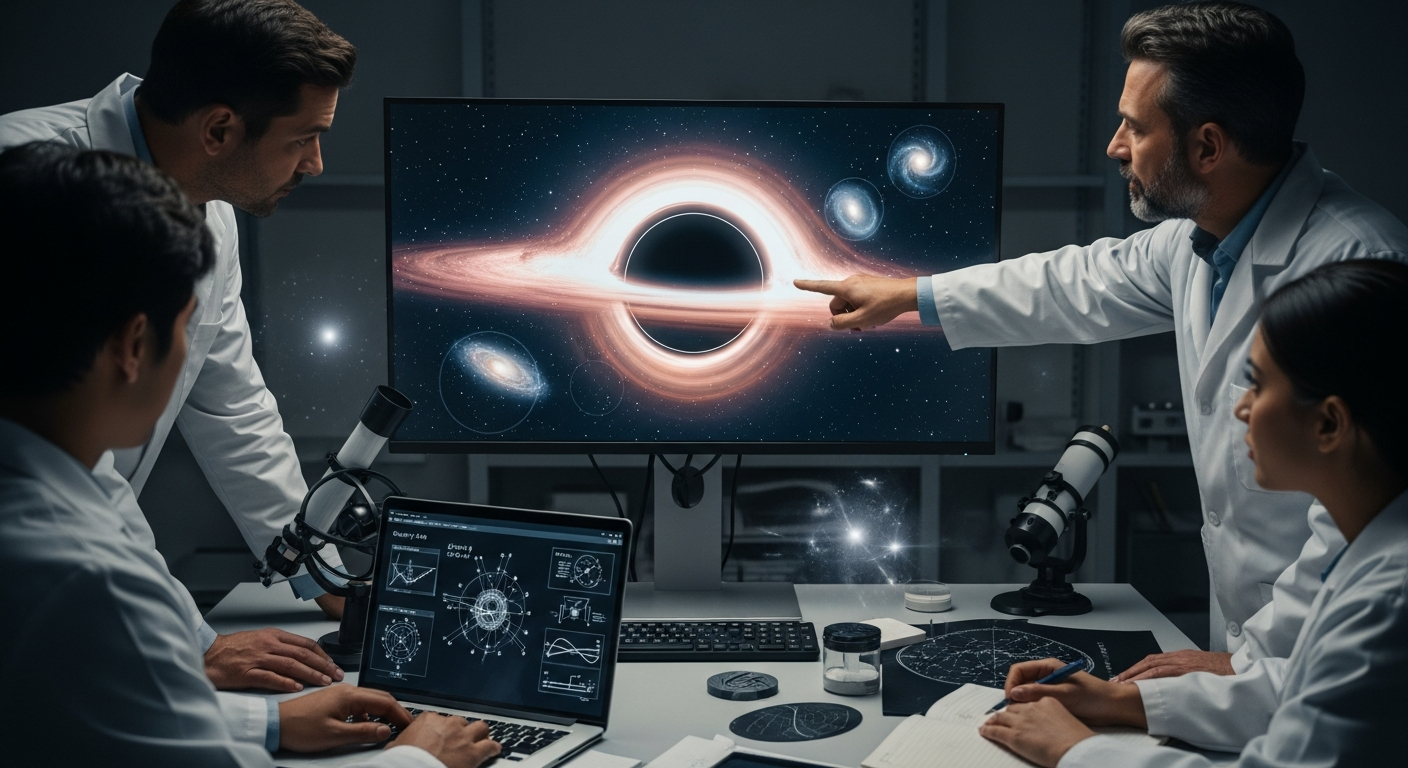
Scientists have proposed that the explosion of a primordial black hole might explain an impossibly powerful subatomic particle collision detected in 2023, potentially solving multiple cosmic mysteries simultaneously.
The Mystery of Exploding Black Holes
While black holes are typically formed from dying stars, a team of researchers has published a study in Physical Review Letters suggesting that a special type of black hole might be capable of exploding. The study examines whether a high-energy neutrino that collided with Earth in 2023 could have originated from such an explosion.
Stephen Hawking theorized that black holes slowly release energy through what is now known as Hawking radiation. Under normal circumstances, this process would take an unfathomably long time—quadrillions upon quadrillions of years beyond the current age of the universe for a black hole to fully evaporate.
Primordial Black Holes: A Special Case
Unlike typical black holes formed from collapsed stars, primordial black holes (PBHs) are theorized to have formed during the extreme conditions shortly after the Big Bang. These PBHs could be extremely small—potentially atom-sized—and have never been directly detected, making them candidates for the mysterious dark matter that constitutes approximately 85% of all mass in the universe.
According to the researchers, smaller black holes would emit more Hawking radiation, becoming increasingly hot as they evaporate, potentially leading to an explosive end. As Andrea Thamm, assistant professor of physics at UMass Amherst and study co-author, explains: “The lighter a black hole is, the hotter it should be and the more particles it will emit… It’s that Hawking radiation that our telescopes can detect.”
Explaining the Unexplainable Neutrino
In 2023, scientists detected a neutrino collision with Earth that released more energy than was thought possible for a single particle. While some suggest this could be an observational error (especially since other observatories didn’t detect it), the researchers propose a more intriguing explanation.
The team hypothesizes that this neutrino could have been produced by a primordial black hole carrying a “dark charge”—a theoretical counterpart to conventional electrical force driven by a “dark electron.” This model could reconcile seemingly contradictory experimental data.
Solving the Dark Matter Mystery
Perhaps most significantly, this theory offers a potential solution to one of cosmology’s biggest puzzles. According to co-author Joaquim Iguaz Juan, “If our hypothesized dark charge is true, then we believe there could be a significant population of PBHs, which would be consistent with other astrophysical observations, and account for all the missing dark matter in the universe.”
Implications and Future Research
While the explanation remains speculative and on the fringe of current physics, it represents an elegant solution that could potentially resolve multiple cosmological mysteries with a single theory. Further observations and theoretical work will be needed to determine if exploding primordial black holes truly exist and whether they could account for both unusual high-energy cosmic particles and the universe’s missing matter.



GIPHY App Key not set. Please check settings