

 Thomas Unise
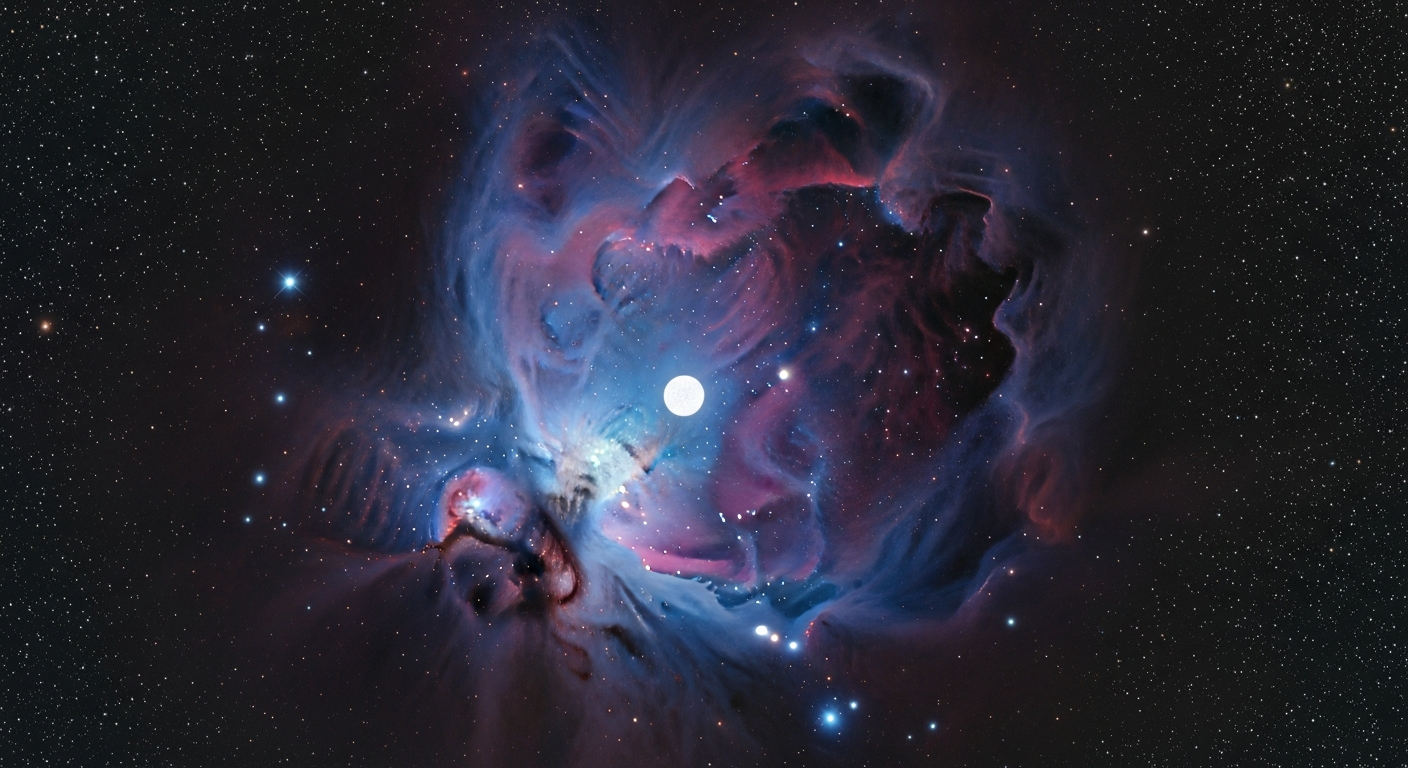
Astronomers have discovered a puzzling cosmic phenomenon 730 light years away that challenges their understanding of stellar physics. A white dwarf star designated RXJ0528+2838 is creating a powerful, luminous nebula structure despite lacking the expected mechanisms to produce such an effect.
The Mysterious White Dwarf System
The white dwarf in question orbits with a Sun-like companion star, forming a binary system. What perplexes scientists is the presence of a highly energetic nebula surrounding the white dwarf, even though there’s no apparent source that could be generating it.
“Our observations reveal a powerful outflow that, according to our current understanding, shouldn’t be there,” explained Krystian Iłkiewicz, co-lead author of the study published in Nature Astronomy.
Breaking the Rules of Stellar Physics
White dwarfs are the dense remnants of moderate-mass stars like our Sun that have exhausted their fuel. In binary systems, white dwarfs typically steal material from their companion stars, creating an accretion disc – a luminous ring of matter around themselves. As the system moves through space, it often creates a bow shock in the surrounding nebula.
What makes RXJ0528+2838 exceptional is that it shows no evidence of an accretion disc, yet still produces a powerful nebula. Images from the European Southern Observatory’s Very Large Telescope also rule out a thermonuclear explosion (nova) as the cause.
Even more remarkably, the size of the bow shock suggests the white dwarf has been producing an outflow for at least 1,000 years – seemingly impossible for a supposedly dead star without an accretion disc.
Possible Explanation
The research team, including co-lead author Simone Scaringi from Durham University, describes the finding as “one of those rare ‘wow’ moments” in astronomy. Their leading hypothesis is that the white dwarf’s powerful magnetic field might somehow be driving these outflows, even without forming the typical accretion disc.
“Our finding shows that even without a disc, these systems can drive powerful outflows, revealing a mechanism we do not yet understand,” Iłkiewicz noted. “This discovery challenges the standard picture of how matter moves and interacts in these extreme binary systems.”
Implications for Astrophysics
This discovery opens up new questions about stellar evolution, binary star interactions, and the physics of white dwarf systems. It suggests that our current models of how matter behaves in extreme cosmic environments may need significant revision.
The research demonstrates that even well-studied cosmic phenomena can still surprise astronomers, highlighting how much remains to be learned about the universe’s fundamental processes.



GIPHY App Key not set. Please check settings